Showing posts with label birds. Show all posts

Tuesday, October 16, 2018

All Shagged Out While Feeding the Eels

Still wanting to be able to work up to a afternoon with the grandfolks I endeavoured to try more time out for a bit.  An opportunity presented itself when Mum dropped by some freshly caught snapper & kahawai, (from a celebratory work trip), two common NZ staple fish with strong distinct flavours.  Kahawai is more commonly smoked while snapper is used for the classic non battered fish & chips.  We were lucky with the portion of kahawai Mum shared with us already having been gutted & bled on the trip.  Which left the snapper to be gutted & filleted at home.

Tasty snapper, chilli lemon pesto and 'chips'
Hubby worked out a grand plan to crumb bite size pieces of kahawai with chana, (chickpea) flour, fresh sage and orange zest.  So post filleting he crumbed and fried the kahawai to eat that night, (as it normally does not keep well hence it is more often smoked).  While we could have some snapper in later days.  We kept the guts, skin etc to feed to the local longfin eels in the nearby creeks and ponds, (much like feeding the ducks except you are less likely to get bitten with eels).  Hubby prepared a lovely herb, lemon zest, ginger and chilli pesto to sit on top of the cooked snapper and we swapped chips for green long beans, (a cheaper & healthier option at the time).
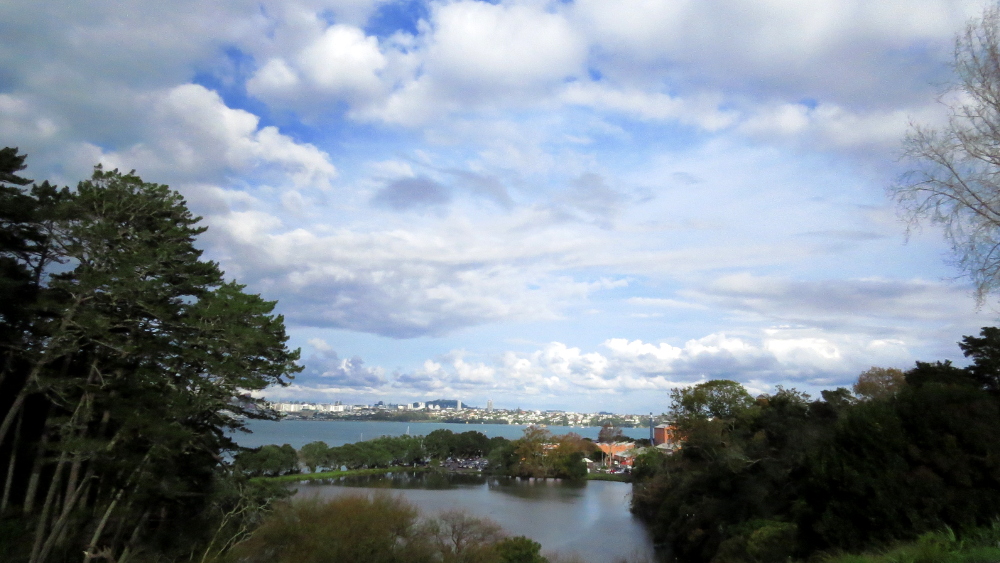
View of one of the ponds, pink Chelsea factory, beach & sea from one of the estate's park areas
We waited for a good day to head out to some local ponds.  The ponds are right next to the coastline in the pink Chelsea sugar factory estate grounds.  Established in the 1880's with classic style houses (prior for some local workers but now rented privately), plenty of manicured garden & natural bush, walking tracks, beachfront and large ponds that are home to several wild species and some waterfowl & carp.  The grounds are open to the public but seeing more than 5 people in the area at a time is busy, (unless it is a shift start/end at the factory), and it is a lovely quiet park were locals can sneak off to eat lunch in peace away from crowds.  In the winding & wide estate there is always a quiet corner.  In this case there is a carpark right next to the pond so all I needed to do was stand and hold onto the car or sit on the hood, which I can maintain for a few minutes (with the trade off with energy later on).

We noticed the eel population had suffered recently from public interactions when we arrived.  I had heard people had illegally been killing them around the area, completely wiping some creeks out altogether (an action that carries a fine).  Where previously groups of large very curious eels, often decades old, (as some can live to over 100 years), would come up to greet newcomers to the ponds there were only a few small eels very scared and unsure of humans.  Probably a good attitude to have given the recent events.  We got the fish guts & tasty tibits out to feed the few there, hopefully they survive the other humans so they can get to the end of their lifetime to breed at least once before death.

We then got to feed some of the ducks including a very excitable muscovy duck which appeared to respond extremely well being called for oats.  Hubby would call to feed ducky some rye oats and when he ran out I would call to feed him some of mine.  This duck knew the deal and was attentive to our moves and which human had the food.  The other grey ducks hung back and waited for the muscovy to finish.  They probably had their fill from another earlier set of duck feeding public as we had come post the lunchtime, er rush.

See if you can spot all the visible shag nesting perches
I got to take photos of the local pied shag colony. In other countries other subspecies in the family are also known as cormorants.  The colony has around 30 pairs which gather & build a nesting colony in the trees on the other side of the pond to the factory.  They still get their sea views and often will fly out en masse, (even though in general the pied shag normally forages alone), before breaking off around the harbour to feed before coming back the the Chelsea estate to nest in the sheltered spot.  I remember it was so strange seeing them fly into the colony as a group, normally you might only see 1 or 2 out in the wharf & beaches by themselves.  They will be rather quiet compared to other birds but will often be sleeping, drying out after swimming & diving for fish and grooming.  However with a colony this large there is bound to be one or two birds calling, but less of a din than if the whole colony was battling to be heard.

They form monogamous breeding pairs and the colony will build up nests over time on the ground or in trees which they seem to share on a first come first nested basis.  I found a breeding pair which were grooming each other and sleeping together often on many days.  They stand out from the crowd a bit and you can see their back feathers are black their undersides are white, the skin in the front of the eye is yellow, the eye ring is blue and the base of the beak is a pink.  Whereas non breeding juveniles have lighter back feathers, more of a black brownish tone, they have some brown mottling on their undersides and there is more grey around their eyes than distinct colours.

Shags & cormorants have a more well known set of distinct postures.  Especially well known is the posture where shags are seen sitting on poles with their wings outspread to dry in the wind.  But there are also several distinct neck & body moves, (say pre-dive and pre-jump), and you can see the expansion of the head in one of the later photos.

All shagged out ourselves we headed back home to finish off the snapper for the night. Well worth the fishy treat. We were so lucky as it had been a couple years since we last had some at home. Hubby will remember the pesto & crumb recipe for later. Definitely a keeper.

I can't look at the rocket launch
The trophy wives of the astronauts
And I won't listen to their words
'Cause I like
Birds

I don't care for walkin' downtown
Crazy auto-car gonna mow me down
Look at all the people like cows in a herd
Well, I like
Birds

If you're small and on a search
I've got a feeder for you to perch on

I can't stand in line at the store
The mean little people are such a bore
But it's alright if you act like a turd
'Cause I like
Birds

If you're small and on a search
I've got a feeder for you to perch on

If you're small and on a search
I've got a feeder for you to perch on
If you're small and on a search
I've got a feeder for you to perch on

Thursday, September 20, 2018

Spring Starting Outside the Door

First to set the scene for spring some music composed by Edvard Grieg, "Peer Gynt - Morning Mood".  I was also thinking of Vivaldi's Four Seasons but Morning Mood is softer & more in turn with a NZ soft spring light, flowers unfurling & bees bobbing between them.  While Vivaldi is quite heavy with very sharp contrasting sections, (definitely not suiting the hyperacusis from hubby's brain injury and me still a bit migrainy).

Outside our door is a native kowhai tree with beautiful yellow drop flowers, pea like seed pods and tuis, NZ native honeyeater birds, fighting over who can claim the tree.  A classic NZ scene of the tui singing in the kowhais in spring.  Tuis also enjoy other nectar trees so the red flowering pohutukawa, (often a symbol of NZ Christmas summer), and the flax with large red flowers often also have a tui come by.  They are an aggressive bird when nesting, even known for bringing down hawks & magpies for flying too close during nesting season.  Hence they can crowd out other native species when they have no serious competition.  So in many areas across NZ you will be able to hear a tui sing when you come by the trees they enjoy.  Hubby can sit and hear the tuis in the trees on the fence line and watch them shoot past on a patrol of the area & heading to the Kowhai to drink the nectar.

When there is more than one tui in the tree the rival visitor is at least given a warning to get out and 'find its own f'in tree'.  The tui who claimed the tree will puff up and 'try to make himself look big', (like the cat from Red Dwarf).  Often this will turn the tui from a sleek bird to a very angry puff ball three times the size.  If the warning is not enough an aerial fight is on.


Once the interloper leaves the successful tui reduces the puffed feathers to about half, and with a chest proudly thrust forward & his white bib held high sings his success.  After a champion sings they usually reduce the puff out of their feathers back to the sleek form and resume feeding.

Tui have two voice boxes, syrinxes, so they perform a variety of noises & songs which can vary widly from chirps & creaks to lyrical calls & high pitch trills.  In the bush they bring a ghostly atmosphere as they sound quite unlike the other birds.  The department of conservation have provided some lovely captures of their voices in the bush.  They are open to listen to and free to the public to download, (the more who experience the tui song the better for NZ tuis).  The first is of a male calling out across his territory, some of the more ghostly sounds & more commonly recognised, while the second is a collection of varied communication calls: croaks, whistles, chirps, creaks, trills, waughus (not a real word I know but an approximation) etc.

When signs of spring come by it is nice to see them by the door so when things get too wobbly & painful there is something not too far away to look at & relax.  The sound of the tuis is a million times better than suburban guys who are mowing a 4sqm patch of grass on their fence line every week.  Hubby has no trouble with the birds and that is perhaps because we enjoyed the bush & outdoors so much that we are so accustomed to them.

Due to the concussion injury the loud sounds of the neighbours and tradesmen cause hubby no end of grief & frustration.  When I have a bad migraine I can understand, where hyperacusis makes loud sounds & certain frequencies quite painful.  There are recordings of the birds, (along with other acoustic atmospheric music tracks e.g. rain, waves), which help to play on headphones to counteract the more painful sounds, along with noise reduction headphones and earplugs.  We often cannot entirely remove the source of the painful sounds or remove ourselves from them so building a tolerance, breathing exercises, sensory modulation and in the worse cases medication helps.

I say this as I had an exceptionally painful migraine lasting a couple of days recently; making me unable to stand, sit, read, blurred vision especially on one side, lots of sharp & throbbing pain along with very painful hyperacusis, even extreme nausea.  Often when I come out from a migraine there is a weird feeling almost as if you woke up after passing out in a seizure for a long time and your mind is not quite grounded & partially trapped still in a dream like haze.  The world has a light and odd atmospheric quality.  About to take flight or stumble & fall in an attempt like a baby bird.  Certainly Edvard Grieg's Morning Mood suits but hubby finds the following song Learning to Fly closer to his heart and I can understand why.  We both listened to Pink Floyd in the womb so to speak and certainly when growing up.  For him the poetry of this song is what he often feels. It captures for both of us feelings with chronic illness quite well.  Certainly for this post we were grounded inside looking at spring arriving outside, but in our minds we flew.


Into the distance a ribbon of black
Stretched to the point of no turning back
A flight of fancy on a windswept field
Standing alone my senses reeled
A fatal attraction is holding me fast how
How can I escape this irresistible grasp?

Can't keep my eyes from the circling skies
Tongue tied and twisted just an earth bound misfit, I

Ice is forming on the tips of my wings
Unheeded warnings I thought I thought of everything
No navigator to find my way home
Unladened, empty and turned to stone

A soul in tension that's learning to fly
Condition grounded but determined to try
Can't keep my eyes from the circling skies
Tongue-tied and twisted just an earth-bound misfit, I

Above the planet on a wing and a prayer,
My grubby halo, a vapor trail in the empty air,
Across the clouds I see my shadow fly
Out of the corner of my watering eye
A dream unthreatened by the morning light
Could blow this soul right through the roof of the night

There's no sensation to compare with this
Suspended animation, a state of bliss
Can't keep my mind from the circling skies
Tongue-tied and twisted just an earth-bound misfit, I

Saturday, August 18, 2018

Kiwi As Pets

It is no myth that pets are good for the soul & help relieve stress & isolation.  A long standing tradition is for humans to be empathetic & need some companionship, even if that companion is just waiting for you to feed them in the morning & night... no I am not talking about marriage.

Dan the goat man, from Purakaunui, takes his pet goat Alex around Potato Point to go camping.  Photo: Stephen Jaquiery, full article: Otago Daily Times  Alex Kidd the goat, has been house-trained, car-trained and boat-trained and to Dan not much different than owning a dog.  Often they will head out camping together or go on walks through the town.

NZ has a lot of sheep, they outnumber the population to a large degree to the point NZ often has the highest density of sheep per unit area in the world.  For 130 years, sheep farming was the country's most important agricultural industry, but it was overtaken by dairy farming in 1987.  So having sheep also as pets was a common tradition.  Lambs often display entertaining bouncing skills as they leap and frolic.  So giving them the opportunity to bounce some more & encouraging them with a large sheep sized trampoline is where they get to develop those skills to bouncy castle levels of glee.

The NZ police are increasing the furry fellows with some camera loving companions, including Snickers the cat who has his own instagram account.

As well as Tia who has joined the team in Porirua. Alternative article link: NZ Herald.

 
Who is stepping into big shoes as Constable Elliot, the police guinea pig commanded respect and love of the locals.  Quite appropriate as the police can have stressful jobs and often need to interact with the community they protect. It helps to have a furry greeting at the door.

Snickers manning the front desk.

There are animals you seek to protect & visit often but you do not own them and leave them to be wild but supported.  The Department of Conservation NZ, DoC, offers protection for a variety of native animals across NZ and keeps an eye and open live stream on the albatross nesting colony.

Rangers check the weight & health of the chicks, offer support in times of water stress and record new births to assess the colony health & numbers.  Albatross mothers & fathers take turns with feeding & on the nest with the chick until they are big enough to be on their own.  Shown above is Ranger Mike helping mother and chick cool down during a rather hot period as heat stress could kill them.

Then there are the times when you cannot have a pet, do not feel the need for one but an animal has chosen to attach itself to you as you may be the one needed.


Paul has formed an unlikely bond with Pete the duck when the paradise shelduck laid eyes on him and decided he was the one.  "I don't know what it is, he's quite protective over me," he told The Project.  "If anyone else comes near me, particularly women, he has a go at them."  To which one of the presenters mentioned, "Paradise ducks, well known fact, mate for life. Paul face it, you are married".

It is these kinds of connections I save to show hubby, because humour and an occasional smile is also good for the soul.  So for a mental cuddle, here is how the relationship of one gay goose and a bisexual swan was the loving relationship of a lifetime.

Excerpt from the BBC article, (follow link for further info):
It all started around 1990 when a black swan named Henrietta flew in to the Waimanu lagoon, located in a small town on New Zealand's Kapiti Coast.  Due to a damaged wing, she was unable to fly with the other swans and was often alone until a few years later when a white goose named Thomas arrived.  The duo quickly formed a bond and Thomas was very protective of Henrietta, even scaring off any humans or dogs that came near her.  But after 18 blissful years together, a new young female swan entered the equation and was often spotted with Henrietta. No one thought much of it, assuming that they were both females.  The shocker came when the new swan laid an egg. It turned out that Henrietta was in fact a male swan who had mated with the new female swan.
"It's very hard to establish the gender of mature black swans," said Michael Peryer, the tour guide at the Waikanae Estuary where the lagoon is located.  "So it turned out in fact that Thomas and Henrietta - who was really a Henry - had 18 happy gay years together."  They stayed together for many years after that and Thomas helped raise the signets.  Only when Henry died did Thomas go on to have his own offspring with another goose and when Thomas died he was buried beside his Henry.

 
  BBC Article on Thomas, Henry and Henrietta

Tribute to Thomas life, epitaph by New Zealand performer Pinky Agnew inscribed on his tombstone:

Here lies Thomas, the great-hearted goose,

Nestled near Henry, in their final roost,

Here where they raised young, and found sanctuary,

Somewhere above us, these great souls fly free. 

Thursday, August 9, 2018

A Break In The Clouds

A mist lays across Muriwai running up it's black sand dunes to the fields beyond. 


During a brief moment of clarity & ability we travelled to the west coast North Island black sand surf beach Muriwai.  A lot of beaches can look picturesque but the rocks and waves are dangerous.  Lately more people, new to the area, are taking risks on the beaches, and during a recent fishing accident 2 people lost their lives.  A family had gone out fishing with their kids off the rocks, the father was swept off by a wave and the mother pulled in after him.  There was a recent blessing ceremony from the locals, rescue staff, & iwi by the beach and another from the Buddhist community.  The weather can turn quickly here, the rocks jagged and slippery.  Volunteer lifeguards put out flags for swimmers & junior surfers on good days.  There is still surfing out during high winds, even during mild hurricanes.  But it is not a forgiving area and the locals know this well, including the local gannets.

 Life can be both fragile and indomitable.

The gannets nest and ride the winds around the cliffs.  You can see their nesting spots they come back to claim each year, waiting to see if their mates return to join them.  We watched them dive & scan the ocean for fish.  Then they would rest on the waves in a group together before launching to make the journey back up the cliffs to their nesting spot.  It can be rough as the gannets face a lot of risk most the year travelling around NZ and Australia before returning for nesting season.  Especially as recently a lot of sea birds have been dying  from dehydration & starvation due to the warm La Nina weather conditions & changes in fish stock.

In before the spring rush picking a good nest spot & tidying it up is imperative.

We could not stay long.  The recovery from hubbies brain injury is slow so his energy wore down quickly.  But at least he had enough time to eat his hot steak and cheese pie.  Feel & taste the fresh sea air.  While I got to take the photos in this post.  I prepared to drive us back with singing breathing exercises to stay focused & keep my mind off the pain.  I am the sort where I got used to doing maths tests with migraines as a teenager, i.e. stubborn wanting to complete a task, through pain, through nausea and if that includes a physical punishment later I pay the price.  It has been a lot to adjust to with chronic fatigue.  ME is a thousand times worse than any migraine and with continuous effects, gut, allergy, flu symptoms, even multi day migraine symptoms and orthostatic intolerance issues so I have to do regular safety checks and be fully certain of my condition & mental acuity.  If I am too far gone to drive, eyesight affected or hands & terrible fatigue it is a no go.  We have backup plans in place, lots of hydration & rest ahead of any planned trip so I only head out on days where I almost approach normal and only for short trips.  The energy never lasts and the punishment can hit like a goat to the groin.  We travelled back on the busy state highways peppered with wineries, farms, orchards and lots of trucks.  Nice drive but it hit me really hard afterwards, with a couple days of a really bad flare.  I had difficulty sitting & speaking and hand control was affected.  Pain intense.   I think it was worth it.  These moments may be fleeting but they are the light coming through the clouds after the storm.

As if hanging by a thread trying to get home.

Lyrics from "Till The Clouds Clear" - Lamb

What's left to say with all that's come and gone
Words get in the way
And anyway the devil's got your tongue
And the storm brews inside
And there's nowhere to hide
It's gonna blow your cover sky high

If you let this thing go
It's gonna burn, it's gonna burn
You're gonna take the whole world with you when you go

What you gonna do?
When the storm takes over
What you gonna do?
When the storm takes over

So here you are,
demons screaming in your head
You try to shut them out
But they just get louder instead
And nothing you do
can seem to break through this darkness smothering you
when it takes hold your heart turns cold
your very soul sneaks out of you

What you gonna do?
When this storm, this storm takes over you
Can you hold this thing?

Till the clouds clear